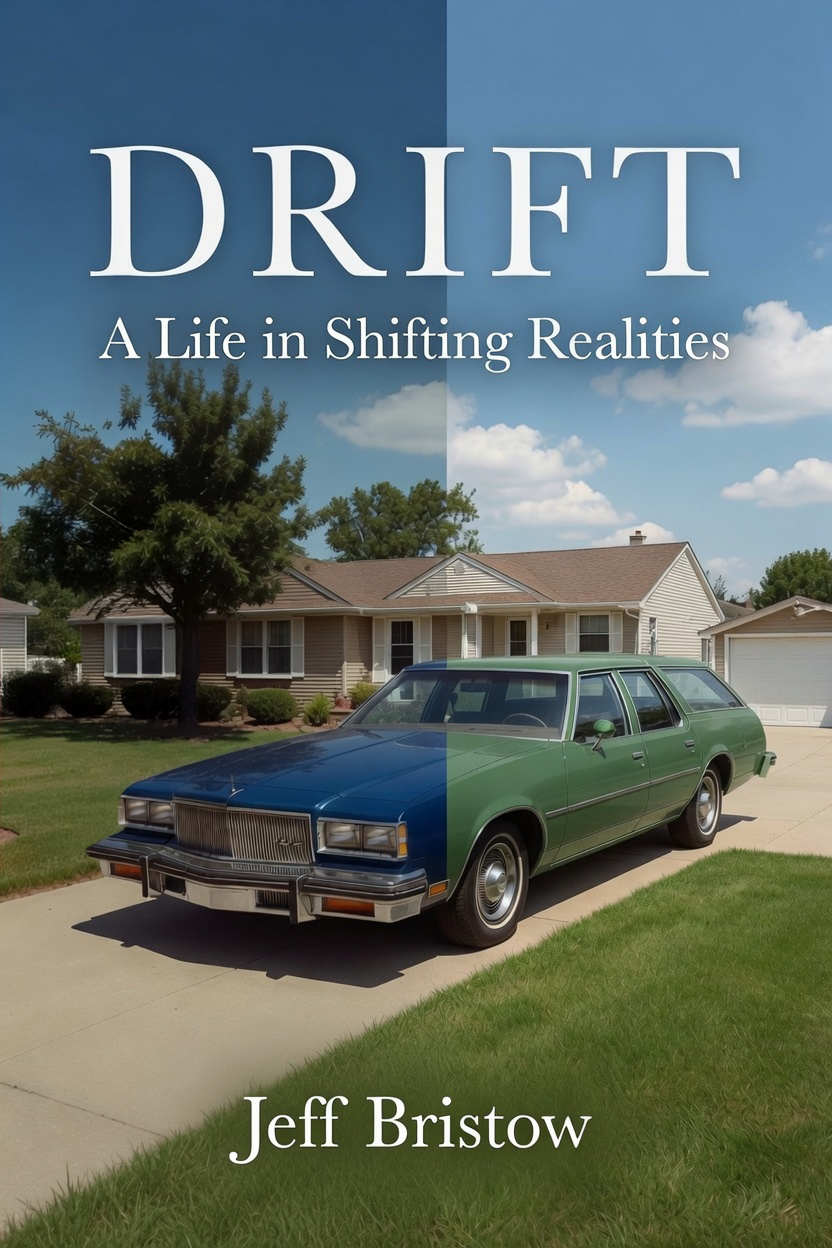
Chapter 1 — Blue Car
The bell rang at three-fifteen and Jay walked out of the second-grade classroom in the long quiet line Mrs. Pell required. He kept his hands at his sides, not talking until the classroom door. On the steps of Glenwood Elementary, once the line broke and the talking started, Jay ran to car rider pickup to find his Mom.
The pickup line went around a half-circle of curb in front of the school. The buses lined up first. The cars came after. He looked for his mother's car the way he always looked for it, by the blue color and the dent in the rear quarter panel where she had backed into a mailbox the summer before last. The dent was the easiest part of the car to find among the other blue cars. The dent caught the light wrong. He caught sight of it from a long way off.
The car was three cars back. He saw the dent. He saw his mother's elbow out the open window, the freckled forearm she'd gotten from her own mother, the wedding band catching the sun. He ran for it.
"Hi, baby," she said when he climbed in. She reached across and pulled his door shut for him because the latch was loose on the inside and he had to slam it twice if he did it himself. "How was Mrs. Pell?"
"Fine."
"What does fine mean?"
"I don't know. She read us a book."
"That sounds less fine and more interesting. What book?"
"Umm.... I don't remember."
She laughed. She had the kind of laugh that started before whatever was funny had finished, like she was already halfway agreeing with the joke. She put the car in drive and they pulled out of the car line behind a yellow sedan that had a lady in it. Jay did not know whose mother was in the yellow car but she smelled like cigarettes through the window of the car she was in, and that was the main thing Jay knew about her.
His mother's car was a 1981 Buick Estate Wagon. He knew this the way he knew his own birthday. He knew the year because his father had told him, and he knew it was a Buick because the word was written in cursive metal across the back. Estate Wagon he had figured out on his own. The interior was a kind of soft tan that had cracked along the top of the dashboard from the sun. The radio only got AM. The seat belts in the back were the old kind that you had to pull across yourself and slot into the buckle without any of the hardware that newer cars had. He had known all of it for as long as he could remember.
His mother drove with one hand on the wheel and the other resting on the seat between them. She was not a tall woman but she sat tall, the way she had told him once that her own mother had taught her to sit. Her hair was the brown that has red in it when the sun is on it directly and is only brown the rest of the time. She wore it pulled back with a tortoiseshell clip he had given her two Christmases ago, picked out himself at the drugstore with his mother standing behind him pretending to have no opinion. She had a habit of tapping her wedding ring against the vinyl seat when she was thinking. She was tapping it now.
"Daddy's home early," she said. "He's fixing the porch step."
"The loose one?"
"The loose one."
"That's good. It scares me at night when I take out the trash. It moves under my foot like it's not all the way there."
She glanced at him. "Baby. Why didn't you say?"
"I'm saying."
"I'll tell Dad. He'll like knowing."
They drove the rest of the way without talking. He watched a dog he didn't know the name of trot along the sidewalk in front of the Methodist church with no person attached to it. He watched the light come through the windshield onto the dashboard, where it caught the cracks in the tan vinyl and made them look like a map of rivers. He liked the rivers. He had liked them for as long as he could remember liking anything.
His father was on his hands and knees on the front porch with a flat carpenter's pencil behind his ear. The radial saw was set up on a sawhorse in the driveway. Jay got out of the car and slammed the door to make sure it closed.
"There he is," his father said, without looking up. "How was your day?"
"Mrs. Pell read us a book about a horse but I can't remember its name. Hannah got a new barrette. I had pizza."
"Wow. That's a report."
"Mom said fine wasn't a report. So I gave you a report."
"Your mother is a wise woman."
His father was a tall man, taller than most of the fathers of the boys in Jay's class. Jay knew because he had watched at the school's father-son night and made a private accounting. He had brown hair going to gray at the sides earlier than seemed fair, and a face that did most of its expressing through his eyebrows. The pencil behind his ear was always there during a project; the pencil was how you knew there was a project. He sat back on his heels and pushed the pencil farther behind his ear and looked at Jay with the look that was his attention given completely, which Jay liked but also found heavy.
"Come here a second," he said. "Hold this."
The 'this' was a board. Jay held it. His father sighted along it and made a mark and took it back and carried it to the saw. The saw screamed for a second and then stopped. His father came back with the board cut and laid it across the gap where the loose step had been.
"Step on it."
Jay stepped on it.
"Bounce."
Jay bounced.
"Solid," his father said. "We'll screw it down after dinner."
His mother came up the walk with the grocery bag from the car. She stopped at the bottom of the steps and looked at the new board and at the two of them and said, "My boys."
"Your boys are hungry," Jay's father said.
"My boys can wait twenty minutes. Tom, Jay told me the old step was scaring him at night. When he takes the trash out."
His father looked at Jay. The eyebrows did something.
"I should've said something earlier," Jay said.
"You said something now," his father said. "That's the part that counts."
His mother went inside. His father reached up and took the pencil from behind his ear and put it in his shirt pocket and stood, knees popping, and put a hand on the back of Jay's neck for a second and then took it off. They went inside together.
Dinner was pork chops and rice and the canned green beans Jay tolerated. His mother asked about the horse book again and he remembered, halfway through the green beans, that the horse's name had been Misty. His father said Misty of Chincoteague and his mother said Yes, that's the one and Jay was pleased to have produced the right answer. After dinner his father went out with the drill and sank four screws into the new step. Jay watched from the screen door. The drill made the same screaming sound as the saw, just smaller.
He went to bed at eight-thirty. His mother read him two pages of a book about a boy who lived on an island and then closed it because his eyes were closing. She turned off the lamp. The hallway light made a line under his door.
He slept.
He saw it through the kitchen window while he was eating cereal. He stopped chewing. His mother was at the counter with her back to him, pouring coffee into the orange thermos she took to work. The radio was on low. The weather was going to be nice. Highs in the upper sixties.
The 1981 Buick Estate Wagon in the driveway was green.
"Mom."
"Mm."
"Whose car is that?"
She looked over her shoulder. She looked at him and then out the window, following his look. "Which car?"
"In the driveway."
"That's my car, baby."
"No, it isn't. Mom, no it isn't."
She put the coffee pot down. She turned around fully. "What?"
"Your car is blue."
She looked at him for a long second. Then she smiled, a small smile, the one she used when he said something that was funny without him meaning it to be. "My car is green, sweetheart. My car has always been green."
"It's blue. It has the dent. It has the dent in the back from when you hit the mailbox at Auntie Linda's."
"It does have the dent in the back from the mailbox at Aunt Linda's."
"Then it's blue. The car with that dent is blue. I was in it yesterday."
She came over to the table. She sat down across from him. She put her hand on his hand, the one not holding the spoon. Her hand was warm from the coffee pot. "Baby. Look at me. The car is green. The car has always been green. You remember the mailbox?"
"I remember the mailbox. I remember the mailbox was painted white and it broke off at the bottom and Uncle Ray had to put it back with a new post. The car was blue when it hit the mailbox."
She looked at him the way she had looked at him the time he had told her, at four, that there was a man in the closet. Patient. A little bit tired.
"Eat your cereal," she said.
He ate his cereal. He did not look at the window again until he had to, getting up to put the bowl in the sink. The car was still green. It was a green that was not very green, more of a green-gray, the color of a pond in fall. It was the wrong color all the way through.
His father came down the stairs in his work shirt and his mother said, in the bright voice she used when she wanted his father to handle something without her having to ask, "Tom. Jay thinks the car used to be blue."
His father looked at him. His father had a way of looking that did not require any of his face to move. "Used to be?"
"No, Dad. Is green. I mean was. Yesterday and the day before. All the days. It changed last night, Dad. I went to sleep and it was blue and now it's green."
"The car?" his father asked.
"The station wagon."
His father looked at his mother. His mother shrugged the smallest possible shrug. His father came over and sat in the chair his mother had been sitting in. He had the cup of coffee his mother had poured him in his hand. He did not drink from it.
"Buddy," his father said. "Walk me through it."
"You picked me up. I mean, Mom picked me up. In the blue car. We came home. You were fixing the step. I bounced on it. Mom told you about me being scared of the old one. We had pork chops."
"All of that happened."
"Yes."
"And the car?"
"Was blue."
His father drank from the coffee. He held the cup in front of his mouth for a second after he drank, looking at Jay over the rim. Then he put the cup down.
"Stay there," he said.
He went into the living room. Jay heard the cabinet under the television open. He heard the soft slap of the photo albums being moved. His father came back with the green album, the one that was the family album and not the wedding one or the baby one, and laid it on the kitchen table and opened it.
"Show me," his father said.
The first page was his parents on the front porch of the first house, the one in Belmont before they had moved to Springfield. The car in the driveway behind them was the station wagon. It was green.
The car at Aunt Linda's, the day of the mailbox. Green. The dent fresh and bright along the rear panel.
Jay's fifth birthday. The cake on the picnic table in the backyard. In the corner of the picture, beyond the fence, the back end of the station wagon parked in the driveway. Green.
His father turned the page.
A picture Jay had not seen in a long time, of him at maybe three or four years old, standing in front of the open hatchback of the station wagon with one small hand resting on the bumper. He was wearing a red shirt. He was looking at the camera with the serious expression he wore in pictures, the one his mother teased him about. The car was green. His own small hand rested on the bumper of the green station wagon.
His father turned the page.
"Look at me," his father said.
Jay looked at him.
"Were you maybe thinking of a different car? Aunt Linda has the blue Cutlass. Sometimes when we visit—"
"It wasn't Auntie Linda's car."
"Okay."
"She has a car. The station wagon is the station wagon. They aren't even the same shape, Dad. They aren't even the same."
"Okay, buddy."
"It was blue."
His father closed the album. He closed it slowly. He looked at Jay for a long time. He did not look angry. He did not look worried in the way Jay's mother had looked worried. He looked like a man who was deciding something.
"Sometimes," his father said, "when we sleep, the brain does things. It mixes things up. It takes the color of something we saw in a dream and puts it on something we saw when we were awake. It happens to me too."
"It does?"
"Sure it does."
"What did it do to you?"
His father thought about it. "Once I was sure," he said, "completely sure, that there was a clock above the bedroom door. I woke up and was looking for it for about a minute before I remembered there had never been a clock there. Your mother thought I'd lost my mind."
"Did she laugh?"
"Yeah, she laughed for a few minutes."
"Okay," Jay said.
"Okay?"
"Okay. I think so. I don't know."
After a moment his father reached across the table and rested his hand on top of Jay's head, the way he sometimes did, and then took it away.
"Get your shoes," his mother said, from the counter. "I'm dropping you off on the way."
He got his shoes. He went out the front door and down the new step, which did not move under his foot, which was solid the way his father had said it would be. He stood on the walk for a second and looked at the car.
It was green.
It was green in a way that did not allow any other color underneath it. It was green at the door handles and green along the chrome trim and green inside the wheel wells where you wouldn't bother to paint a thing if you were painting it new. It was a car that had been green for a long time. He could see that. He was seven, but he could see that.
He got in. His mother slammed the door for him because the latch was loose on the inside.
She drove him to school. She talked, on the way, about the weather and about the field trip on Friday that he had a permission slip for in his backpack and about whether he wanted spaghetti or chicken for dinner. He answered when she asked him to answer. He looked out the window at the houses going by. He watched the dog, the one he didn't know the name of, trot along in front of the Methodist church with no person attached to it. He watched the light come through the windshield onto the dashboard, where it caught the cracks in the tan vinyl and made them look like a map of rivers. The rivers were the same rivers.
The dashboard was the same. The seats were the same. The smell was the same: his mother's lotion and old french fries from a McDonald's trip the summer before, and underneath those, the smell of the car itself, which was a smell he could not have described but would have known in a dark room.
Everything was the same.
He did not finish the thought. He set it down somewhere in the back of himself, carefully, the way his father set down a tool he was going to need again later.
At Glenwood he got out and shut the door of the green station wagon. His mother waved and pulled away. He watched the back of the car go down the loop, the dent catching the morning light, and he watched the green of it for as long as he could, until it turned out of the school driveway and onto the road and was gone.
That night, in bed, he asked his mother if he could see the album again. She sat on the edge of the bed and turned the pages with him and named the people and the places. When they got to the picture of him at three or four with his hand on the station wagon, he stopped her hand with his hand, and he looked at it for a long time.
"That's a good one," his mother said. "You were so serious."
"I was thinking about something."
"What?"
"I don't remember."
She kissed the top of his head and she stood up and she said goodnight and she closed the door behind her almost all the way, the way he liked it, with the line of hallway light coming under it. He heard her go down the stairs. He heard the sound of the dishwasher starting. He heard, faintly, the radio in the kitchen.
He looked at the picture.
He looked at it for a long time.
He did not put the album away.
He fell asleep with it open on the bed beside him, his small hand resting on the page, on the green station wagon, on the picture of himself looking out at a camera that had been held by someone he could not remember.
Chapter 2 — Grandmother
The cartoons were on.
Jay sat on the carpet too close to the television, the way his mother told him not to, and watched a coyote fall off a cliff. The coyote made the small puff of dust at the bottom of the canyon that meant nothing was hurt. A sign appeared in the coyote's hands. The sign said HELP.
It was Saturday. Outside the front window, the snow had come down overnight and put a clean line on top of the mailbox and the porch railing. The snow had quieted the street. It was a different quiet from a street with no snow on it. Jay knew the difference. He couldn't have explained why.
His mother called from the kitchen. "Jay. Back up from the screen. You're nine years old, you know better."
He scooted back maybe six inches. He did not take his eyes off the coyote. He had been doing the same six-inch scoot for as long as he could remember, and his mother had been pretending it was enough for almost as long.
The phone rang in the kitchen.
He did not turn his head. The coyote was holding an anvil now. He heard his mother's slippers on the linoleum and then her voice, low, the way she answered the phone before she knew who was calling. Then her voice changed. It got smaller and went flat.
"Oh," she said. "Oh, Linda."
He turned the volume down on the television without taking his eyes off it.
"When?" his mother said.
He could hear her breathing. He could hear the refrigerator. The coyote had become small in the corner of the screen, far away at the bottom of a canyon, and Jay was no longer watching him.
"I'll come," his mother said. "Of course I'll come. Tom can drive. Let me — let me just — yes. Yes. I love you too."
She hung up the phone. She did not come into the living room right away. He heard the tap run and then stop. He heard her open a cabinet and close it without taking anything out.
When she came in she had her hand at her neck. She sat down on the couch behind him and said his name.
"Jay."
He turned around.
"Grandma's gone, sweetheart."
He looked at her. He waited to feel what he was supposed to feel. He thought about his grandmother, who lived three hours away in a small house with a screened porch, who had given him a wooden bird the last time they had visited, a bird carved from a single piece of wood with the wings still attached at the tips so it could not really fly. The bird was upstairs on his dresser. He thought about the bird before he thought about her face, and that seemed wrong, so he tried to think about her face.
Something shifted in his chest, low and a little heavy, and he didn't have a name for it.
"Okay," he said.
His mother's eyes filled. She held out her arms. He got up off the carpet and went to her and let her hold him, and after a while the cartoons were still on, just quiet, and the coyote was running again.
His father drove. The roads had been plowed but not salted, and the car moved carefully through the long flat country between Springfield and the town where his grandmother had lived. His mother sat in the passenger seat with her head against the window. She was not crying anymore. She had cried in the bathroom for a long time before they left and had come out with her face washed and her hair pinned back and had said, "All right," to no one in particular, and then they had gotten in the car.
Jay sat in the back with his coat across his lap because the heater was good. He watched the fields go by. The fields had snow on them but the corn stubble showed through in rows, and from the car the rows looked like they were turning, slow, lining up and then sliding apart as the car passed.
"Mom," he said, after a while.
"Mm."
"What did Grandma teach? Before she retired."
His mother did not turn her head from the window. "She was a nurse, baby."
His father's eyes came up in the rearview mirror.
He looked at the back of her head.
The wooden bird upstairs on his dresser had come from the trip last summer, and on that trip his grandmother had taken him out to the screened porch after dinner and shown him a stack of yearbooks from the school where she had taught. She had taught fifth grade. She had shown him a picture of a boy with big ears and said, this one became a dentist, can you believe it. She had laughed at the picture. The yearbooks had smelled like an attic.
"Did she ever teach school?" he said.
"No, honey."
"Are you sure?"
His father's eyes again, in the mirror. His mother turned her head, finally, and looked at him over the seat. Her eyes were red and tired and she was trying to be patient.
"She was a nurse, Jay. Thirty-two years at the county hospital."
He put his hands flat on his thighs and pressed down.
"Okay," he said.
He looked back out the window at the rows of corn stubble turning under the snow. He thought about the yearbooks. He thought about the smell of them. He thought about the boy with big ears who had become a dentist. He thought, for the first time that day, about how he might be wrong, and the thought sat in him for a moment and then moved on. Adults got things wrong all the time. His mother had told him last month that she had never owned a yellow jacket, and Jay remembered the yellow coat. His father had said he had never been to Niagara Falls, and there was a picture of him at Niagara Falls on the bookshelf in the den. Adults forgot. That was just what they did. The yearbooks were real. He had held them.
The car drove on.
The funeral home smelled like flowers and something else underneath that wasn't quite the flowers. Jay stood to his mother's left in the receiving line, half a step behind her, in the new shirt she had bought him that morning at a department store along the way. The collar was stiff. He kept reaching up to pull it away from his neck and his mother kept reaching down and gently moving his hand back.
People came through and said I'm so sorry and she was a wonderful woman. Some of them said if there's anything we can do. His mother said thank you and thank you for coming and sometimes she said the person's name, and the person's face would change a little, grateful to be remembered on a day when so much was being forgotten.
A small woman with very white hair and a black coat took his mother's hands.
"Your mother saved my life," the woman said.
"Oh, Mrs. Doyle."
"In '71. When I came in with the —" She made a small gesture at her own chest. "She held my hand the whole time. I was so scared. She held my hand the whole time and she told me I was going to be all right and I was."
His mother's eyes filled and she said thank you, thank you for telling me that, and the woman nodded and patted his mother's hand and moved on.
Jay watched her go.
He looked up at his mother.
"At the hospital?" he said.
"What, honey?"
"Grandma. She held that lady's hand at the hospital?"
"Yes."
"Because she was a nurse?"
His mother looked down at him. Her face went through something quickly, a small flicker, and then settled.
"Yes, Jay. She was a nurse."
He turned back toward the door so she couldn't see his face. His eyes began to water. He pressed the inside of his wrist against his eyes to help dry them up. He looked down at the floor. He looked at his Mother's shoes. He breathed. After a moment he regained control over his eyes.
"I'm sorry," he said. "I keep — I keep forgetting."
She put her hand on the back of his head and held it there.
"It's okay, baby. It's a hard day."
He stood very still under her hand. He was not forgetting. He knew he was not forgetting. His grandmother had taught fifth grade for thirty years at a school called Lincoln Elementary, and the boy with the big ears had become a dentist, and in the summer the screened porch had smelled like cut grass and the lake, and she had owned Pepper and then Gus, and before them an orange cat whose name he couldn't remember now no matter how hard he pressed on it. He knew all of this. He did not say any of it.
His mother's hand on the back of his head was warm.
He kept his mouth shut.
Aunt Linda was at the front of the room near the casket, talking to a man in a dark suit. Linda was taller than his mother and wore her hair short. She had the same eyes as his mother and the same way of pressing her lips together when she was trying not to cry. Jay had always liked her. She kept gum in her purse.
When she saw him she crossed the room and crouched down and pulled him into her arms. She smelled like cold air and a perfume he did not know.
"Hi, buddy."
"Hi."
"You doing okay?"
"Yeah."
She held him for a second longer and then leaned back and looked at him. Her mascara had smeared a little under one eye. She wet her thumb and rubbed at it and made it worse.
"You hanging in there?"
"Yeah."
"Liar," she said softly. She smiled when she said it. "Me too."
She stood up. She put her hand on his shoulder and they both looked toward the casket at the front of the room, where his grandmother was, and was not.
"She loved you so much, Jay. She used to call me up and tell me what you'd said the last time you visited. Word for word. She'd be on the phone for an hour."
"Really?"
"Oh, yeah. She thought you were the smartest kid in three counties. Smarter than her own three put together, she said."
He looked up at her.
"Her three what?"
Linda looked down at him. She blinked.
"Her three kids."
"You and Mom," he said.
Linda's face did something he could not read.
"And David," she said.
"Who's David?"
His aunt's hand tightened on his shoulder.
"Honey," she said. "David. My older brother. Your uncle." She looked at him more closely. "Oh, sweetheart, you don't know about David."
He shook his head.
"I don't."
"He passed when he was very young," she said. Her voice had gotten very gentle. "Before you were born. A long time before. Your mom and I —" She stopped. "We don't talk about him much. It was hard on Grandma. But there was a David, honey. There were three of us."
"Oh," he said.
He looked at her. He looked at her face, which was his mother's face but longer and sadder, and he tried to think of a David. He could not. He could think of his mother and Aunt Linda and the photographs on his grandmother's mantel of his mother and Aunt Linda as little girls in matching Easter dresses. He was sure of this. He had counted them, the way he counted things, because counting was something he did. There had been two photos on the mantel. There had been two girls.
He felt his shoulder go rigid under her hand. He didn't move, he just stood there and let it happen, and after a moment his shoulder was just his shoulder again and he was still standing and nothing had changed in the room.
"Okay," he said.
"Are you all right?"
"Yeah."
"You can ask your mom about him later if you want."
"Okay."
She kissed the top of his head and stood up and went back to the man with the dark suit, and Jay stood in the new stiff shirt and looked at the casket at the front of the room.
He found a chair in the corner near a table of small sandwiches he did not want to eat. The chair was against the wall next to a window that looked out at the parking lot. He sat down and watched the room.
He put his hand against the inside of his coat pocket where he had been keeping the wooden bird since they left the house. He had put it in his pocket without really deciding to. He did not know why he had brought it. The wood was warm now from being against him.
His grandmother had carved that bird. He was sure she had carved it. She had whittled in the evenings on the screened porch, with a small knife and a piece of soft wood, and she had given him the bird the last summer they visited, and she had said don't tell your mother I gave you a knife, even though it wasn't a knife, it was a bird. She had laughed when she said it.
He held the bird through the lining of his coat.
The casket was open. He had not gone up to it. His mother had asked him if he wanted to and he had said no, and she had said that was all right, that it was all right not to want to. From across the room he could see only the top edge of it, dark wood with a soft shine on it, and a flower arrangement in front that he could not see past.
He took the bird out of his pocket, under the table where no one could see, and held it in both hands and looked at it. The wings were still attached at the tips. The eye was a small dark dot the size of the head of a pin. He did not know how she had made the eye.
His eyes started watering again. He tipped his head back and looked up at the ceiling tiles. There were brown water stains on two of them, spreading out from the corners. He counted the water stains. He kept his chin up until his eyes dried.
He put the bird back in his pocket.
He kept his hand on it for the rest of the afternoon.
In the car on the way home it was completely dark and the snow had started again and the headlights cut a tunnel through it. His father drove slowly. His mother had her head against the window again. She had cried a little at the end and then not anymore, and Jay had heard her tell his father in the parking lot that she was empty, that there was nothing left, and his father had said I know, honey, and had opened the car door for her.
Jay watched the snow come at the windshield. The flakes seemed to come from a single point far ahead of the car and rush outward, parting around them. It was the kind of thing he could watch for a long time.
"Mom," he said.
"Mm."
"Tell me about David."
The car was quiet for a long second. His mother lifted her head from the window.
"What, sweetheart?"
"David."
She turned around in her seat and looked at him. Her face in the dashboard light was very tired.
"How do you know about David?"
"Aunt Linda said."
"Oh."
She looked at his father. His father did not take his eyes off the road. After a moment his mother turned more toward Jay, her arm along the back of her seat.
"David was a boy," she said. "He was Linda and my brother. He was sick when he was born. He only lived a few years. Years and years before you. Grandma didn't talk about him very often. It was a sad thing for her."
"I didn't know about him."
"I know. We didn't tell you. There wasn't really a — there wasn't really an occasion to tell you, sweetie. He was just so young. We have one picture of him."
"Where?"
"At Grandma's. On her mantel."
He thought about his grandmother's living room. He had been there more times than he could remember. There was a couch with a quilt on it that had small brown squares and small yellow squares. There was a fireplace against the far wall. On the mantel above there was a photograph of his grandfather in his Army uniform and a photograph of his mother and Aunt Linda in their matching Easter dresses and a small bowl that held earrings. There was no photograph of a boy. He was sure of this.
"Okay," he said.
His mother looked at him for another moment, and then she turned back around and put her head against the window again.
He sat in the back seat in the warm dark of the car with the wooden bird in his coat pocket and watched the snow rush past the windshield. He did not say anything else for the rest of the drive.
It was very late when they got home. His mother went upstairs without speaking. His father said, Bed, buddy, and Jay said, Okay, and went up.
In his room he turned on the small lamp on his desk and not the overhead light. He took off the new stiff shirt and put on a t-shirt and pajama pants. He put the wooden bird back on his dresser, in the place it had been, between a model airplane and a jar of acorns. The bird looked the same as it always had. He stood and looked at it for a while.
He sat down at his desk.
He had a stack of school notebooks in the top drawer, the spiral-bound kind with cardboard covers in different colors. He took out a blue one that was empty. He had been saving it for something but he had not known what he was saving it for.
He opened it to the first page.
He sat with the pen in his hand for a long time. He wasn't sure what to write. He knew that what he wanted to write was not the kind of thing you wrote down. He knew that if his mother found this notebook she would be sad or worried, and he did not want her to be either of those things because she was already so sad and so tired since Grandma had just died.
He thought about it for a while.
At the top of the page, in his careful printing, he wrote:
THINGS PEOPLE FORGET
He looked at it.
It seemed like a true title. It seemed like the kind of title that would be okay if anyone read it, because everyone knew that people forget things. Adults forgot things constantly. His mother had forgotten the yellow jacket. His father had forgotten Niagara Falls. It was an ordinary thing, forgetting, and a list of things people had forgotten was an ordinary kind of list, the kind a careful boy might keep.
He started writing.
1. Mom's yellow coat. She had it when I was little. She wore it to take me to the park. She says she never had a yellow coat.
2. Dad at Niagara Falls. There is a picture in the den. He says he was never there.
3. The car was blue and now it is green. Mom says it has always been green.
He paused. He chewed the end of the pen.
4. Grandma was a teacher at Lincoln Elementary. She taught fifth grade for a long time. Today everyone said she was a nurse. She was a nurse for thirty-two years at the county hospital.
He pressed the pen too hard writing that last part and the letters came out thick and dug into the page. He looked at them. He kept going.
He read the entry twice. He thought about the boy with big ears who had become a dentist. He thought about the smell of the yearbooks. He thought about the small woman with the white hair who had said his grandmother had held her hand. He believed the woman. He had seen her face when she said it. He believed that his grandmother had held her hand at the hospital. He also believed that his grandmother had taught fifth grade at Lincoln Elementary, because he had held the yearbooks himself.
He wrote, underneath:
Both could be true.
He looked at that. It did not feel like enough. He crossed it out and wrote:
Maybe she did both.
He looked at that. It also did not feel like enough but it felt closer.
He kept writing.
5. There were two girls on the mantel at Grandma's house in the Easter dresses. Mom and Aunt Linda. Aunt Linda said today there were three kids. There was a boy named David. Mom said David died before I was born. I did not know about David. There is no picture of David on Grandma's mantel.
He stopped.
He read what he had written.
He thought about whether to add Maybe I just didn't see the picture, which was a thing he could write, and which would be the kind of thing a fair boy would write, the kind of boy who admitted he could be wrong about a picture.
He did not write it.
Instead, at the bottom of the page, he wrote:
Adults forget things.
He underlined it. He started to underline it a second time and then stopped and put the pen down.
He closed the notebook. He held it against his chest for a moment. Then he opened the second drawer of his desk, the deeper one, and put the notebook at the bottom under his old math workbooks, where his mother would not find it because his mother did not look in the second drawer. The first drawer was for school. The second drawer was for him.
He turned off the lamp.
In the dark he could see the shape of the wooden bird on the dresser against the lighter shape of the window behind it. The snow had stopped. The streetlight at the end of the driveway came through the window and put a pale square on the carpet. Down the hall he could hear his mother crying again, very quietly, and his father's voice, low and steady, saying something he could not make out.
He lay down on his side and faced the wall.
He thought about his grandmother. He tried, hard, to picture her at the hospital, in a white uniform, holding a frightened woman's hand. He could almost see it. He could almost. Then the picture would slip, and she would be on the screened porch in the summer with a yearbook on her knees, laughing at the boy with the big ears, and he would have to start over.
He stayed awake for a long time doing this. His chest had a low heavy feeling. It didn't really ease. He stopped waiting for it to ease and just laid there with his feelings.
He put his hand under his pillow and closed his eyes and listened to the house, and to his own breathing, and he thought, before he slept: I will write it down. I will write all of it down. So I will know.
Down the hall his mother had gone quiet. His father too.
He could feel cold air coming off the window from across the room.